Monday, 27 July 2015

A Pretty Muddy Run with Type 1 Diabetes


As promised, here's my video about taking on the Race For Life Pretty Muddy Run!

Enjoy!


Ninjabetic x 


SHARE:

Sunday, 6 October 2013

The 4Ts - After diagnosis


The 4Ts campaign was launched by Diabetes UK in order to make people aware of the signs of undiagnosed Diabetes. Knowing these signs could prevent a person from going into diabetic ketoacidosis, which can be fatal.  

The signs to look out for are; 

  • Thirst
  • Toilet
  • Thinner
  • Tired

You can read more on this campaign here 


However it's important for people to recognise that the symptoms that present at diagnosis don't always end there. 11 years after being diagnosed I still experience these symptoms.

I can only share my personal reasons for why this has happened in the past and occasionally now, and hopefully by sharing them it may give a little insight into how we can help and support others who are displaying the 4Ts.

Here are a few of mine:


Education

A lack of diabetes education can lead to all sorts of difficulties and, for some, complications. Diabetes is a life long learning process and educations needs to start from the very beginning. Structured education is incredibly helpful as the next step from basic education, and it allows us to think of strategies to adapt to our own lives... Being given a leaflet some insulin pens and a blood glucose meter, then being sent on your merry way... Not so helpful. 

Here are a few educational tools that would have made a big difference to my diabetes management:


Carb counting - Is everyone taught how to carb count from the start? Well no, they aren't, but how long is it before people are informed of this amazing self management tool? 

For me... 9 years. 

It wasn't long until I was put on a basal bolus regime, and for 9 years I was told to take exactly the same amount of insulin 4 times a day and to avoid sugary food and drinks - that was all. I didn't use the internet or social media to educate myself about diabetes until 2 years ago; otherwise I'm sure I would have discovered carb counting for myself. I relied on my health professionals to give me the information I needed to control my blood sugars, but from the start it wasn't delivered. 

And then one day I was told about a wonderful educational programme (JIGSAW) that not only taught me how to carb count, but almost everything else I needed to know about my diabetes. As insightful and helpful as this was I couldn't help but feel a little sad and disappointed that I hadn't been offered it sooner. I understand that staff are stretched, money is tight and time is precious... but for 9 years...

Corrective doses - I had no idea that I could take a little more insulin, without food, if my blood sugars were too high. On being told this 2 years ago I was shocked... Can I really take insulin without food? It was like I was being exposed to a whole new world... My blood sugars improved dramatically after this discovery. Combined with being able to carb count, I felt like a whole new person.

Rotate injection sites - Again, I didn't know this until 2 years ago! 9 years of injecting into my legs caused hard lumps and extra fat deposits to develop. These lumps change the way insulin is absorbed, making it more difficult to keep your blood sugars within target. For me this also contributed to high blood sugars, I just didn't know it at the time. 


Needle Phobia

Pre-diagnosis I disliked needles, but post-diagnosis I feared them, to the point that stopped injecting. A phobia is an irrational fear of a particular situation or object and I avoided both in any way I could. 

I was labelled as 'non compliant' even though I had admitted my fear of needles on a number of occasions in appointments. I made no secret of why I didn't get my hba1c done, but never was there a suggestion made to help me around this problem. To this day none of my health professionals have even approached the subject and I was even told by one only a few months ago; "You do not have a fear of needles".

I accepted that I wasn't going to be given help on this one, so I found my own way around it... I studied a psychology module about phobias in patients - I chose to concentrate on needle phobia and from this I found my own self help strategies.


Stress 

This one's a pain in the pancreas. Stress can make a person do some strange things, but it can also make blood sugars do some equally strange things. 

When we're stressed (physically or emotionally) our stress hormones kick and raise our blood sugars in order to help us deal with the situation. However for those of us who have diabetes, bringing those blood sugars down can be tricky. 

Recent prolonged stress has left me with the 4Ts - I couldn't remove the stressor, therefore I was/am tired, thirsty, thinner and going to the toilet more often. Whilst it was happening no matter what I did to try to bring my blood sugars down they would not budge.

Stress can also affect appetites, causing blood sugars to go off target. I lost my appetite for weeks, it came back with a vengeance (comfort eating) and then off it went again. 

On seeing my consultant last week I realised that I should have gone to him much sooner than I did. I tried my best to adjust my regime and combat the high blood sugars, but being unsuccessful only added to the problem. A few comforting words, an understanding wink and a review of my sugars has helped immensely. 


Control and Rebellion

Control - This is a strange one for me - Being in good control of blood sugars, diet, exercise, and overall diabetes management can be incredibly empowering and rewarding. 

However control can also be a form of protection from hurt and pain that may have been experienced - usually it's reinforcing the problem that has caused it, and therefore not protecting us from it. Not testing blood sugars and not injecting can be forms of control in people's lives.

This leads me to...

Rebellion - Not a cry for help as some would think. I was once described as a covert rebel. I would sit and smile sweetly in appointments, but secretly I was thinking of different directions to take, escape routes and ways to cheat my clever health professionals. I didn't want to submit to their authority. In the past I'd only experienced rushed appointments with little or no change in their structure, leaving me with little or no change in myself. I wasn't given any reason to feel wanted... I felt I was simply there as a hospital number.

And today...

Today things are different... I can see the mistakes that I made and the mistakes that were made with regards to my treatment. I can see the different options that are available to me if I open my eyes and ears. I can see that if I want something I have to go out there and get it for myself... but I can also see others who are still struggling to get what they need for many reasons, and as I said before; hopefully by sharing our experiences and showing understanding we can help and support them through those 4Ts.

Please feel free to add any of your own reasons for why you still experience the 4Ts and how you have been helped/helped yourself in overcoming them.

Ninja x


SHARE:

Thursday, 11 April 2013

Insulin pump trial - Week 1


So a few of you may have heard me mentioning that I started my insulin pump trial. This is a 6 month trial with frequent reviews at my diabetes clinic to ensure that I’m getting the best out of my pump and that I can use it safely.


Before starting I sat down with my consultant and set myself 4 goals to achieve by the end of the trial:

  • Reducing my A1c by 5mmol/mol
  • Maintaining a healthy weight and BMI
  • Reducing blood glucose variability by 20%
  • Reducing hypoglycaemia experience by 30%


I’ve already attended a diabetes educational course (JIGSAW) and intense insulin therapy appointments (for almost a year) to try to improve my control. Now I need to make sure that an insulin pump is going to be effective treatment for me. Once my 6 months is up my pre and post trial data will be sent away to the CCG (people with the money) to assess my need to keep the pump.

Go time!

The night before my start date I ran through all of my biggest pump worries.

These were:

  • Inserting the cannula myself
  • Being able to hide the pump in my clothes
  • Catching the tubing on handles/people/my dog/anything that sticks out
  • Hypos/DKA


After a week of having my pump (named Iain after my consultant) the only issue that I’ve had is with inserting the cannula. However this reminded me of when I first started injecting, when I would spend ages trying to put the needle in. Soon after diagnosis I had no issues, so I really hope that I will get to that stage soon with my pump.


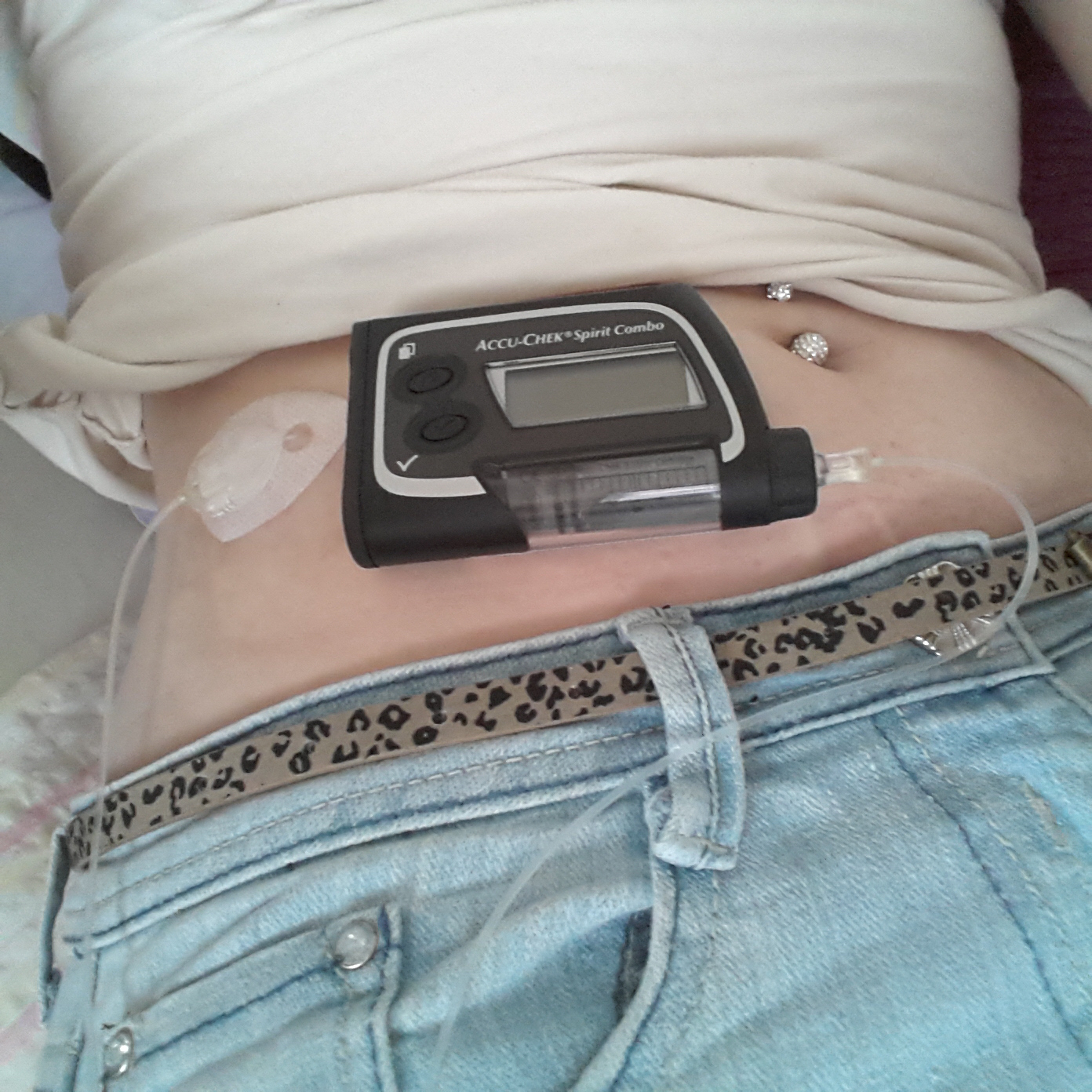
Iain the Pump - Accu-Chek Spirit Combo


After 2 days of pumping I was amazed at my blood sugars readings and how controlled they had become, I fell in love with Iain the pump (and soon regretted calling him Iain). Pre and post meals blood sugars were within my target of 5-10 and although I was having a few lows my rebound highs weren’t anywhere near as bad as they were when I was on MDI (multiple daily injections). I actually look forward to testing my sugars now, whereas before I used to dread seeing my readings because I would feel so disappointed with myself if they were off of target (which was quite often).


Taken today - After 1 week of using the pump


All in all my 1st week of being a pumper has been a big turning point for me. If I’m honest I was starting to despair with my diabetes and it was really upsetting me, to the point that it affected my life far too much. Now I have a lot more hope and have a positive outlook again.


If there’s anyone out there who is thinking about insulin pump therapy then I would definitely recommend you give it a go if it’s possible (I know it’s not always easy to get one). And if it’s not for you, then at least you’ve tried!


Ninjabetic x
SHARE:

Sunday, 29 July 2012

50 Shades Of DKA


I'm sure that many people have read or heard of the novel 50 Shades Of Grey... If you haven't then here's a very short summary (close your eyes if you don't want to know what happens).

Girl meets guy... guy is dangerous for girl... girl can see the danger but doesn't know how to stop... girl keeps going back for more...

When I think about DKA (diabetic ketoacidosis) that is how I see my experience, a dangerous pattern which sucked me in time and time again. DKA broke me so many times and in so many ways, and after I fixed myself and picked myself back up I would allow my diabetes to chip away at me until I was too weak to fight it again.

For those who haven't experienced or don't know what DKA is here's a short blurb to explain more...

"Diabetic Ketoacidosis occurs when the body cannot use sugar (glucose) as a fuel source because there is little or no insulin. Fat is used as fuel instead. As fats are broken down, acids called ketones build up in the blood. In high levels, ketones are poisonous.
The signs and symptoms of DKA are: Deep rapid breathing, dry mouth, flushed face, nausea and vomiting, abdominal pain, decreased appetite, decreased consciousness, dulled senses, frequent urination and increased thirst."

Recently a fellow ninjabetic, Danie, experienced DKA for the first time since being diagnoses 15 years ago. Danie had been ill for a while and unfortunately this had lead to her being admitted to hospital with DKA. I remembered that we had briefly spoken 1-2 months ago about what it felt like to go through it and I hoped that she never would. I felt instant guilt at the fact that Danie had been through this terrible experience when she had taken measures to prevent it, yet I had openly exposed myself to it on a number of occasions.

In previous blogs I have explained that it was a 6 monthly occurrence for me... a bit of a routine in my diabetes life. The agonising pains and confusion, being unable to breathe or even walk were all quickly forgotten about within a few short weeks and the build up would start over again.

So the DKA was that guy... aggressive unstable and menacing. My problem was that I didn't know how to escape the vicious circle that I seemed to be trapped in, I didn't know how to stop. My consultants would visit me while I was in hospital and ask why it had happened. "I forgot to take my insulin" I would tell them innocently. "I promise I won't do it again" hoping that my big puppy dog eyes would work. They would then make me an appointment a few days later to discuss ways of preventing it and I would sit in that appointment completely numb with an invisible barrier around myself.

For me accepting help from someone who didn't understand and showing that I needed to lean on someone else was frightening! So frightening that I would put myself in a position which could have cost me my life.

The thing about DKA is that it isn't only the "there and then" that affects a person, it's the weeks and months after that creep up slowly and sometimes silently which need to be looked out for. It's all very well having an appointment after an admission but what happens to the person who feels unable to connect with their HCPs? What happens when GP and clinic appointments start to feel generic? What happens when the advice given seems to be turned out from a book with no feeling or empathy behind it? Is that when people start unknowingly and unwillingly going back for more?

I realise that most people who experience DKA do not purposely subject themselves to it. Was I naive and ignorant to go through it so many times? Was I selfish to add myself to the NHS statistics? Yes but at the same time was I scared and withdrawn because I thought that no one could help me? Did I feel like a lost cause because between those appointments I felt that I was alone and was struggling to cope? Yes again! There are always reasons for why these things happen and just because I wasn't shouting it from the rooftops and symptoms weren't always visible, that doesn't mean that it doesn't exist and shouldn't be addressed.

When my consultant suggested I start a diabetes forum I thought it would be great for me to share my experiences with other people and to prevent them from making the same mistakes that I have, but there was nothing that could be done for me. I had accepted that I was destined for another DKA in 6 months time but maybe I could stop others from having that same destiny. After going through 9 years of hospital admissions I feel like I've found the missing piece to the puzzle! I had no idea that the diabetes online community would give me so much hope and positivity.

Recently another Ninjabetic, Hannah, told me that she'd had a dream that I was taken into hospital with DKA. I thought back to when that had last happened and realised that it was 15 months ago. When I spoke to Danie about her admission I said that it would be interesting to compare our outpatient care following an admission. Thinking about it has made me come to the conclusion that combined with the medical advice that I recieve,  speaking to people who completely understand is one of the most effective outpatient treatments that I could wish for. Every day that I'm speaking to people with diabetes and their famlies is another step away from putting my body and mind through another DKA and I can hopefully do the same for others.


I had an email from a young girl with type 1 diabetes recently saying that she wished I could be there to hold her hand in appointments because even though she is surrounded by HCPs constantly she still feels very alone and misunderstood. I know what she means, I really do, and I plan to email this blog to her as I know how she enjoys the 50 Shades trilogy... but also to remind her that after the second instalment (50 Shades Darker) comes the finale... 50 Shades Freed.


Ninjabetic

SHARE:

Saturday, 23 June 2012

The emotional rollercoaster


Everyone has had one of those days or weeks where they feel that nothing is going their way, that what they do just isn't enough and they feel like giving up. We all go through it and the majority of the time we look back and say "what was all the fuss about"?

When we can see that a friend or colleague is having a tough time we do what we can to support them and make their life that little bit easier. We asses the situation and think of the solution.

How would you feel if that tough time or bad day was on repeat, maybe not all of the time, but enough that it starts to have an effect on your health? How would you feel if you had been diagnosed with a chronic condition which would alter your life and at times become overwhelming? How would you feel if you had no one to turn to and the only option was to cope on your own? Most people reading this will be able to relate in some way, whether they have diabetes or care for someone who does. At some point support will be needed, but it needs to be available.

When it comes to diabetes, support can be a tricky area to discuss. Sometimes it can be difficult to admit that emotional support is needed. Maybe it isn't clear that it's avaliable. We may require more help than what has been offered. We may worry that we are becoming a burden on our HCPs or feel that we are letting ourselves down by accepting help.

When my consultant and I started discussing the idea of ninjabetic, I obviously thought that it would be great. But I also thought, why hasn't this been offered before? If support has not been offered to me, then how many other people are missing out on it? Or had I just fallen through the system and become lost on the list? Have other people been craving support like I was, but haven't received it for whatever reason?

On Tuesday night, after a day of battling with my blood sugars and a stomach bug, I was about to give up and go to bed when my inbox pinged. The first thing I noticed was the name, someone who I knew but we hadn't spoken for over a year. Then next to it in the subject box - 'can I be a ninjabetic too'. The email was from one of my consultant's patients telling me that she had been diagnosed at 16 as well, and that she had learnt a lot from my blogs. I sent one back to say thanks and that we had actually met a few times before, but I wasn't a ninjabetic at the time. She replied saying that she did remember me and she had no idea that I had diabetes. She also said that she feels more in the 'diabetic loop' now, which did make me smile!

So we had hung out before, chatted and had mutual friends but neither of us knew that the other had diabetes. We go to the same hospital, have the same consultant, live in the same area but had been introduced in completely different circumstances. I've found myself wondering if things may have been different for me if I had been introduced someone else who had diabetes in my earlier years, or if I'd had emotional support offered to me.

Don't get me wrong, my consultant's nurse's and dietitian's are great (most people know how much I rate them), and there is only so much they can do when they see a patient twice a year for a check up. But when they see that a patient is avoiding appointments, hasn't had a blood test in years and has non-compliant practically stamped on their forehead, shouldn't alarm bells start ringing? If GPs can see that blood sugars are unstable, prescriptions for insulin and test strips aren't being ordered for months and infections are becoming more frequant, why aren't conversations taking place as to why this is happening?

Then again, maybe they are taking place? But what can HCPs do if they can't recruit the essential help which not only us, but they are crying out for? They must be as frustrated as we are at the lack of psychological support available to us, yet our frustrations still aren't being recognised. I realise that yet again what we are lacking in our care is down to money, but in the long run surely this would be an investment?

I only started to take care of myself and my diabetes this time last year when complications set in. I don't blame anyone but myself for what has happened to me, but I can't help but think, what if?
I would hate for other people to get to the stage where they have made my mistakes and are thinking the same. There are so many ways in which this can be prevented and we all know that the benefits will be huge! If people are given the correct emotional support combined with education and the correct treatment then there is no reason for us not to self manage our diabetes, to save HCPs time, to save money on hospital admissions and to become role models for those who are starting out with their diabetes.

It would be fantastic to have a professional who can give us the time we need, to help us make sense of what is happening, to give our parents and siblings support as well and to listen and offer advice to get us through the tough times.

Peer support is also essential, at any age and any stage throughout diabetes. It costs nothing (I have demanded an ipad from my consultant, but he flat out refuses), and it can be so motivating and inspiring. I don't think that I would have gotten as far as I have without the people who I speak to every day via social media. But also when I met other people with diabetes at Diabetes UK last month, I realised what I had been missing out on. I got on the train to go home and I felt really down, but I didn't know why. Throughout the whole day I had been soaking up the experience of being with those people and suddenly my mood had flipped. But then I realised it was because I didn't want to say goodbye to them. I wanted to put them in my pocket and take them all home with me because I needed their company, not all of the time, but occasionally. Having support on the internet is amazing, but having a face to talk to, seeing someone nodding because they understand, that would really help too.

Yesterday I asked this question on twitter; "Were you offered counselling when diagnosed with diabetes? Have you been offered it since? Did or would it help with your diabetes?"

24 people replied to this question and out of the 24, only 1 person had been offered emotional support. I spoke to people with diabetes and parents and every single one of them said that it has been needed in the past, is needed now and they feel that it will lead to huge improvements in care and management if it is delivered. We are clearly aware of what we need and as we all know, there is strength in numbers. Patient power can go such a long way if you work with HCPs, who can in turn go to the higher powers, the one's who can make this happen, and say "this is what our patients want need and deserve".

Diabetes is not just about the illness, but the person. Diabetes is not a hospital number, it is not a twice yearly appointment, it is not a name on a clipboard at the foot of a hospital bed, it's a part of us for every second of the day and we control it. If we are supplied with what we need, then we can control it well. If we aren't then people may be left wondering....what if?


Ninjabetic x 
SHARE:
© It's me, Laura Marie

This site uses cookies from Google to deliver its services - Click here for information.

Blogger Template Created by pipdig